Small again: MINI revisits the city-car formula it invented
 © MINI
Design chief Holger Hampf confirms MINI is studying a sub-Cooper hatchback, but ADAS and safety rules make small cars hard.
Author: Polina Kotikova
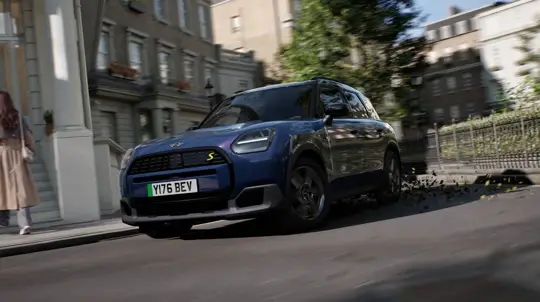
MINI may return to the idea of a truly small car. Design chief Holger Hampf has confirmed the company is studying a model around 3.6 m long — shorter than today’s Cooper and closer in format to the Fiat 500.
For MINI that is almost a return to its roots. The original 1959 Mini was just 3.05 m long and built around a simple idea: minimum exterior footprint, maximum useful space inside. But the brand’s modern cars have grown. The electric Cooper measures 3.86 m, the petrol three-door Cooper 3.88 m, and the five-door 4.04 m. The Aceman stretches to 4.08 m, the Countryman to 4.43 m.
In other words, MINI now plays in the B and C segments, and the brand has no model in the A-class of city cars. That is exactly where a new compact hatchback could fit. The idea is not new: back in 2011 MINI showed the Rocketman concept, which hinted at a cheaper, smaller model below the Hatch. But the project never reached production.

Hampf is cautious: building a modern 3.6-metre car is far harder than simply shrinking a body. “It has to be super safe. We meet these five-star NCAP requirements; we have very, very good safety ratings,” the designer said.
The problem is that buyers are no longer willing to give up driver-assistance systems, cruise control, sensors and modern electronics. Add pedestrian-protection rules and passive-safety requirements on top. All of it takes up space, adds weight and forces even small cars to grow.
A quick debut is not on the cards. The Cooper and Countryman will be updated in 2027 and the Aceman in 2028, so a small MINI is unlikely to appear before the next decade. But the idea looks logical: a brand that built its name on compactness ought to offer, once again, a car that does not need to be explained as “almost a Mini”.
This English edition was prepared using AI translation under editorial oversight by SpeedMe. The original reporting is by Polina Kotikova
Latest Stories