Xpeng Land Carrier: first flying car mass-production line
Xpeng opens the world’s first mass-production line for flying cars
Xpeng Land Carrier: first flying car mass-production line
Xpeng’s Aridge opens a flying car production line for the modular Land Carrier, aiming 10,000 units and autonomous flight, with deliveries starting in 2026.
2025-11-04T01:33:37+03:00
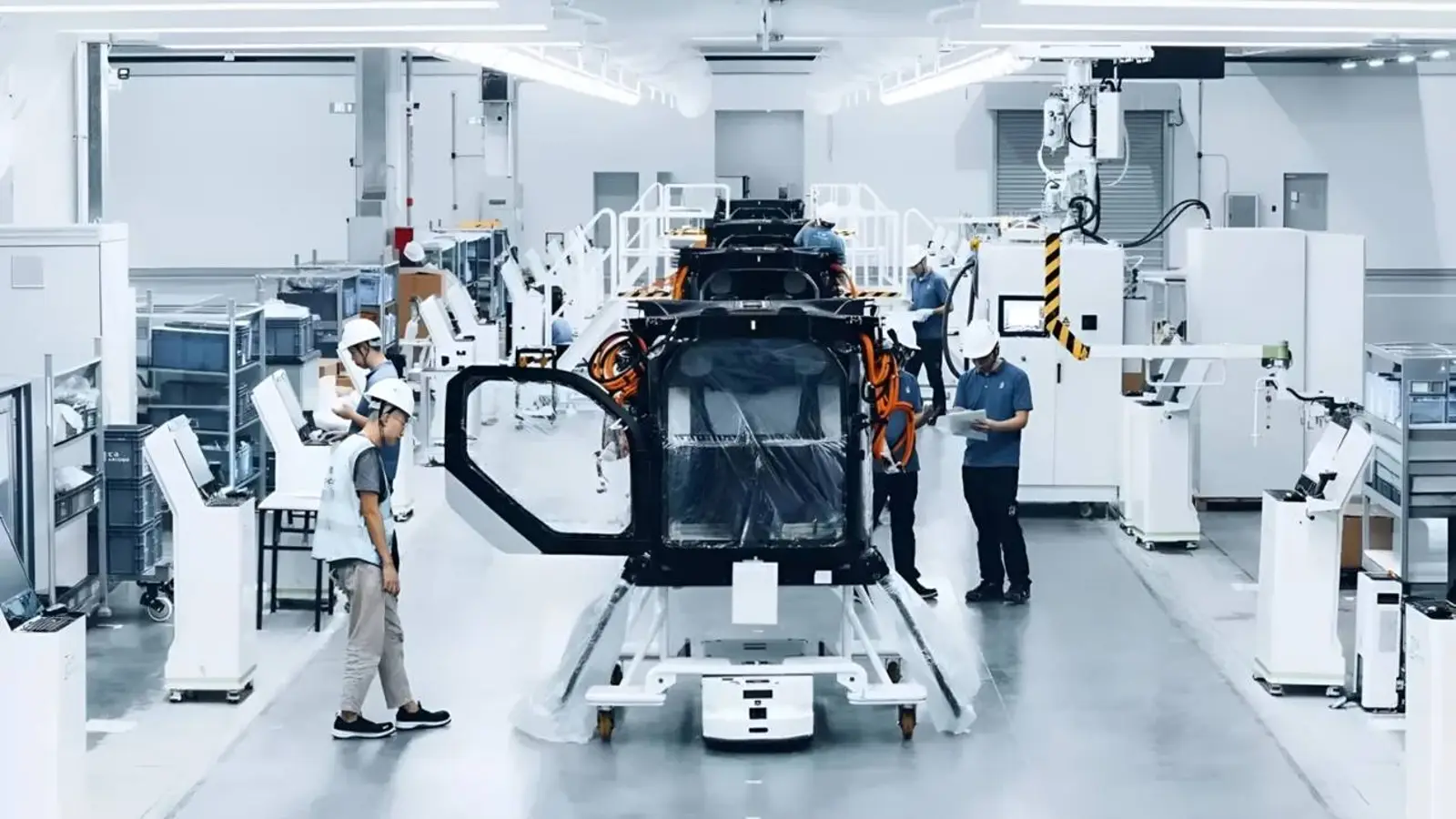
Chinese automaker Xpeng Motors has taken a bold step toward future mobility by launching the world’s first mass-production line for flying cars. At its Guangzhou plant, subsidiary Aridge has begun building a modular aircraft called the Land Carrier that blends a road vehicle with a drone. For a field long defined by one-off prototypes, a true production line feels like a real milestone.The Land Carrier is a two-part system: a ground module—a three-axle, six-wheel electric vehicle with all-wheel drive and rear-wheel steering—and an air module fitted with six rotors and a carbon-fiber body. At 5.5 meters long, 2 meters wide, and 2 meters high, it fits into standard parking spaces. Flights can be controlled manually via a single joystick or handled fully autonomously with route auto-planning and automatic landing. The two-piece layout comes across as a practical compromise, preserving everyday usability while isolating the flight hardware.The 120,000-square-meter production complex includes five main shops: composites, motors, assembly, paint, and final integration. The factory can turn out up to 10,000 units a year, with one flying car rolling off the line every 30 minutes. That cadence signals a serious industrial push rather than a showpiece.The first Land Carrier will be used for test flights, and series deliveries are planned for 2026. The project signals Xpeng’s ambition to lead a new segment of personal air mobility by bringing together car manufacturing, aviation, and artificial intelligence. If the schedule holds, it may shape how these worlds converge in practice.
Xpeng, Aridge, Land Carrier, flying car, mass production line, Guangzhou plant, modular aircraft, personal air mobility, autonomous flight, six rotors, carbon fiber, EV, deliveries 2026
2025
Michael Powers
news
Xpeng opens the world’s first mass-production line for flying cars
Xpeng’s Aridge opens a flying car production line for the modular Land Carrier, aiming 10,000 units and autonomous flight, with deliveries starting in 2026.
Michael Powers, Editor
Chinese automaker Xpeng Motors has taken a bold step toward future mobility by launching the world’s first mass-production line for flying cars. At its Guangzhou plant, subsidiary Aridge has begun building a modular aircraft called the Land Carrier that blends a road vehicle with a drone. For a field long defined by one-off prototypes, a true production line feels like a real milestone.
The Land Carrier is a two-part system: a ground module—a three-axle, six-wheel electric vehicle with all-wheel drive and rear-wheel steering—and an air module fitted with six rotors and a carbon-fiber body. At 5.5 meters long, 2 meters wide, and 2 meters high, it fits into standard parking spaces. Flights can be controlled manually via a single joystick or handled fully autonomously with route auto-planning and automatic landing. The two-piece layout comes across as a practical compromise, preserving everyday usability while isolating the flight hardware.
The 120,000-square-meter production complex includes five main shops: composites, motors, assembly, paint, and final integration. The factory can turn out up to 10,000 units a year, with one flying car rolling off the line every 30 minutes. That cadence signals a serious industrial push rather than a showpiece.
The first Land Carrier will be used for test flights, and series deliveries are planned for 2026. The project signals Xpeng’s ambition to lead a new segment of personal air mobility by bringing together car manufacturing, aviation, and artificial intelligence. If the schedule holds, it may shape how these worlds converge in practice.