
GM’s new patent reveals a purely mechanical adaptive damper
 © uspto.gov
General Motors patents a purely mechanical adaptive damper that varies stiffness via groove-guided valve discs—no electronics. See how it improves ride and grip.
Author: Yulia Ivanchik
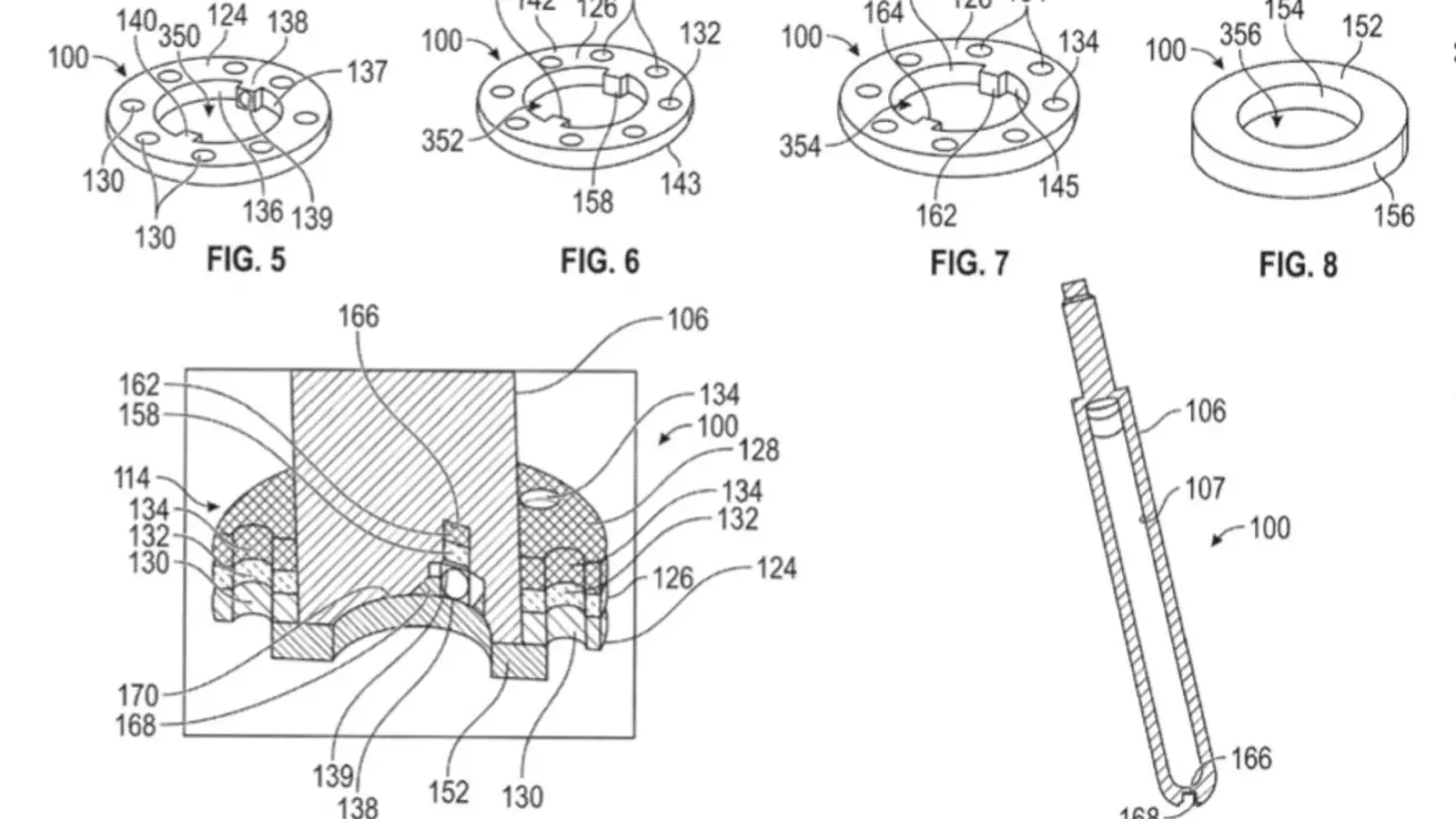
General Motors has filed a patent for a new adaptive damper design that adjusts suspension stiffness through mechanical processes alone. Application US 2025/0361920 A1 was submitted in May 2024 and published in November 2025.
At the core of the concept is a guide rod with an intricate groove profile that combines central and helical sections. Inside the damper are two valve discs with openings for oil flow. Over minor road imperfections the discs remain aligned, allowing fluid to pass freely and keeping the ride compliant.
As suspension travel increases—on bigger impacts or during cornering—the components shift along the sloped sections of the grooves. This movement rotates the valve discs and partially covers their openings, which raises hydraulic resistance and firms up the damper.
The key distinction of GM’s design is the absence of complex electronics, sensors, and actuators. The system adapts to driving conditions through its internal mechanics. According to the concept, that should sharpen the balance between comfort and handling while improving reliability.
The idea comes across as an elegant middle way: adaptive behavior without the added complexity of control hardware. If executed precisely, it could preserve a gentle, everyday ride yet tighten body control when needed. As ever, the result will hinge on calibration and build quality—how the groove geometry and disc alignment are matched—so that the transitions feel seamless from behind the wheel.
This English edition was prepared using AI translation under editorial oversight by SpeedMe. The original reporting is by Yulia Ivanchik
Latest Stories