Xiaomi Longjia battery warranty: when a fire qualifies for a replacement car
 © A. Krivonosov / SPEEDME
Xiaomi's Longjia battery program covers a replacement vehicle after a battery-caused fire and a separate insurance-gap payment after crash damage.
Author: Polina Kotikova
Xiaomi really is prepared to replace an entire vehicle if its new Longjia battery catches fire, but only when two conditions are met: the cause must be a defect in the original battery and the vehicle must be declared a total loss. So the slogan “battery caught fire — got a new car” is far too broad.
Xiaomi unveiled the Longjia Battery Safety Assurance program on September 4 together with CALB and Sunwoda. It is free for the first owner of a non-commercial vehicle, applies for the life of the vehicle and has no annual mileage cap. If an original-battery quality defect causes spontaneous combustion and the vehicle is written off, Xiaomi promises a car with an equivalent specification.
The rules are fundamentally different after a crash. If the battery burns because of a collision or damage to the underbody and the vehicle has to be written off, Xiaomi does not promise a second car. Instead, the company will cover the difference between the insured value under the vehicle-damage policy and the amount actually paid by the insurer. That limitation is what disappears from the loudest headlines about the program.
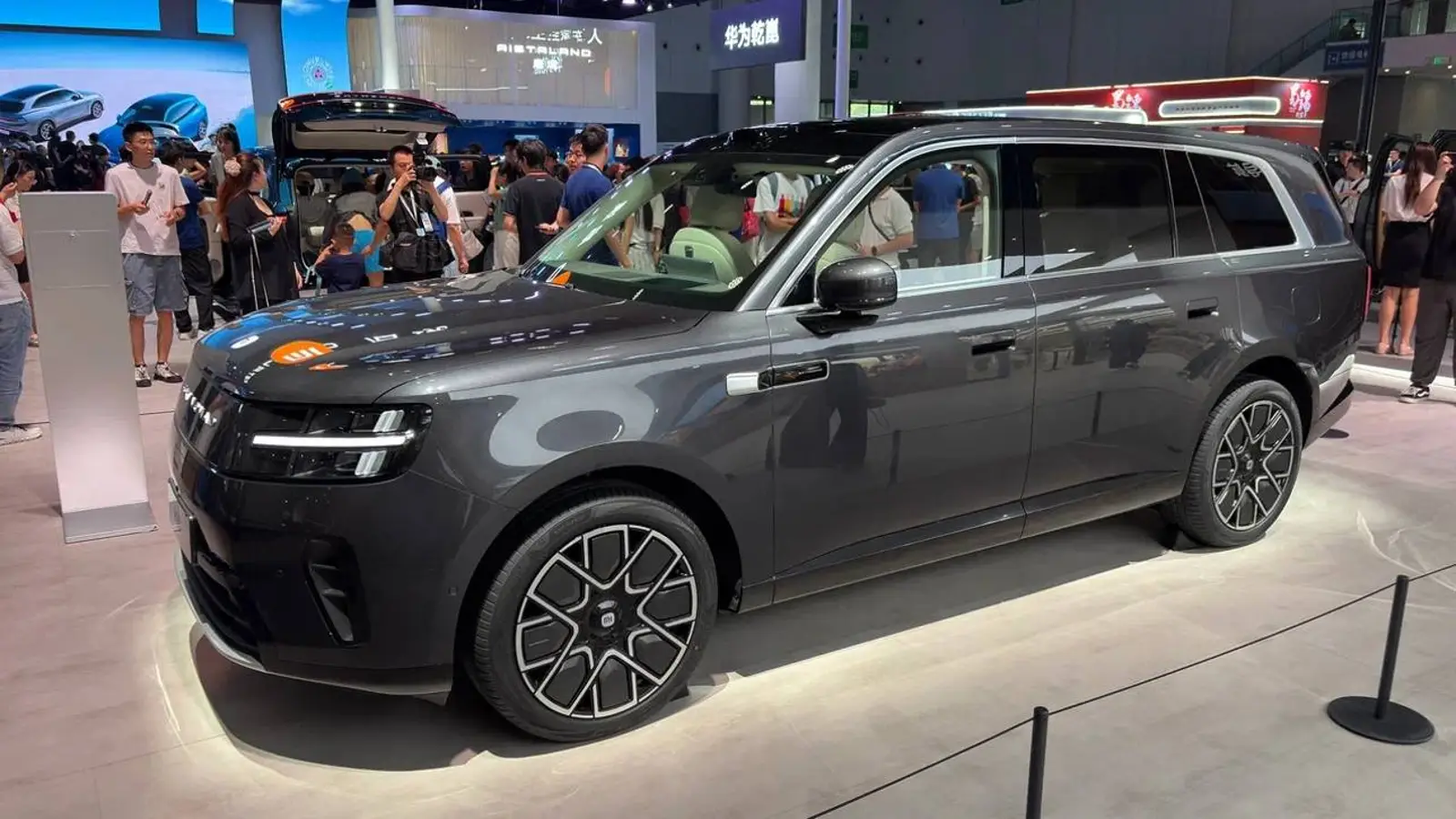
Longjia does not use cells made by Xiaomi itself. Xiaomi defines the system parameters, leads development of the battery pack, participates in cell design and oversees production, while the cells are supplied by CALB and Sunwoda. The first models to receive the new system will be the Xiaomi Pengcheng/Skynomad series, whose official launch is scheduled for September 7.
The five-seat N70 Max version with a 76 kWh battery is rated for 505 km of electric range on the CLTC cycle. The seven-seat N90 Max also uses a 76 kWh pack; its official page lists 464 km of electric range and up to 1705 km in total with the gasoline generator. At the N90 Max's live showing in Chengdu, this unusually large battery for an EREV was already one of the model's main distinguishing features.
According to Xiaomi, Longjia can withstand an underbody impact with 500 J of energy, while at 55 °C and a full charge, thermal runaway in one cell should not propagate to the others. China's GB 38031-2025 standard took effect on July 1, 2026 and includes a mandatory battery underbody-impact test. Xiaomi's figures are still manufacturer test results rather than real-world operating statistics.
There is another correction to the dramatic announcement: Xiaomi was not the first company in China to promise a new car when a vehicle is destroyed by a battery defect. Chery introduced a similar new-vehicle compensation policy for Rhino batteries on July 1 when thermal runaway is caused by the battery itself. Xiaomi adds another layer of protection — separate compensation when a fire follows a collision or underbody damage.
The real novelty, then, is not the formula “fire = new car,” but the separation of two scenarios and Xiaomi's decision to define its responsibility for the consequences in advance. How well those promises work in practice should become clearer once N70 and N90 deliveries begin and the full contractual terms of the program are published.
This English edition was prepared using AI translation under editorial oversight by SpeedMe. The original reporting is by Polina Kotikova
Latest Stories