Nio fifth-generation battery swap station 2026: launch date, compatibility and station count
 © nio.com
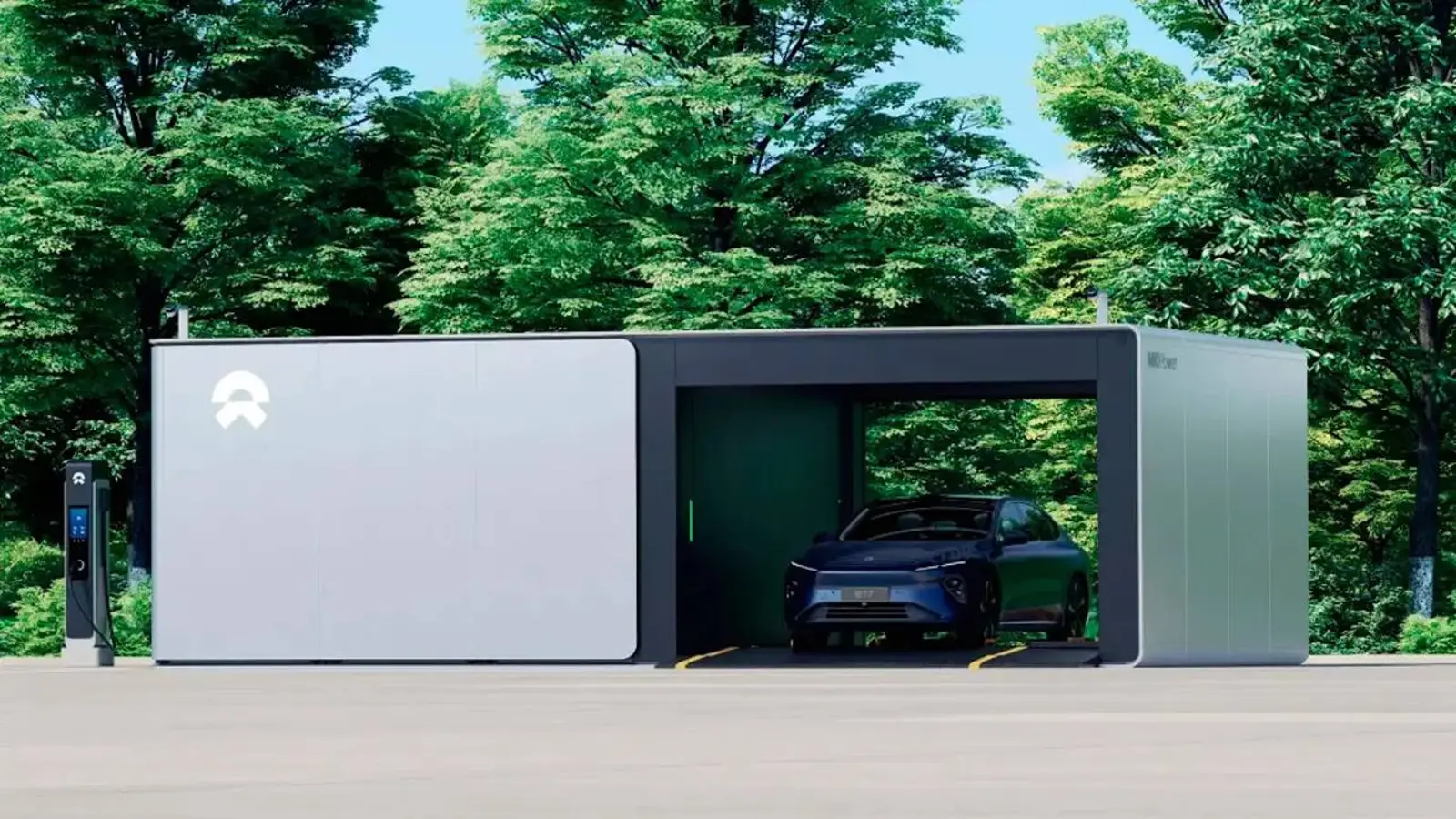
Nio will open its first fifth-generation battery swap station in Quanzhou in early August, the network’s 4,000th site in China, built to serve cars from 4 to 5.3 meters long.
Author: Nikita Novikov
Nio will bring its first fifth-generation battery swap station online in early August. The site in Quanzhou will simultaneously become the network’s 4,000th location in China. The key upgrade is broader compatibility: a single station will be able to service both the compact Firefly, at 4,003 mm long, and the flagship Nio ES9, at roughly 5.3 meters.
According to CnEVPost, the existing Chinese network counts 3,992 stations, of which 1,048 sit along highways. They have already handled around 119 million automated battery swaps — the company recently marked a milestone of 1 million cars sold with ET9 Limited Edition battery swaps.
Earlier stations couldn’t accommodate the Firefly because of its short wheelbase. The new architecture is built for a wider range of dimensions, so the same infrastructure will serve the main Nio brand, the family-oriented Onvo, and the city-focused Firefly. Testing of the system with the compact model began in late June across six Chinese cities.
That said, this is a shared station, not necessarily a single universal battery for every car. Nio hasn’t yet disclosed the full list of compatible batteries, the number of storage slots, or how long a swap takes on a production fifth-generation station.
So it’s too early to say the new hardware will be faster than the old. A fourth-generation station holds up to 23 batteries, completes a swap in about 144 seconds, and handles a maximum of 480 operations a day. The confirmed advantage of the next version is working with cars of substantially different sizes.
Nio intends to add more than 1,000 stations in China during 2026. Part of that expansion will come through partners: an agreement with Zhongan Energy covers the joint construction of 500 locations within a year. That model lowers the manufacturer’s capital burden and raises each station’s utilization across three brands.
The infrastructure push lines up with Nio’s decision to focus on the Chinese market again. At the same time, CATL is stepping up competition, also building out its own charging and battery-swap network.
This English edition was prepared using AI translation under editorial oversight by SpeedMe. The original reporting is by Nikita Novikov
Latest Stories