Bugatti Destrier 2026: specs, W16 power and Pebble Beach debut
 © newsroom.bugatti.com
Bugatti has stripped the track-only Bolide of its rear wing and aero addenda to create Destrier, a one-off standing just one metre tall. The W16 stays at 1600 PS, and the public debut comes during Monterey Car Week.
Author: Nikita Novikov
Bugatti has taken the huge rear wing and most of the aggressive aerodynamic addenda off the track-only Bolide, while moving from 18-inch wheels to 20 inches at the front and 21 inches at the rear. The result is Destrier, the lowest car in the marque’s history at roughly one metre tall, and the third creation of Programme Solitaire after Brouillard and F.K.P. Hommage. The programme builds no more than two unique cars a year, and unlike the first two commissions, which were shaped around specific chapters of Bugatti history, Destrier began as pure design.
The carbon fibre monocoque of the Bolide remains underneath, but the body has been developed from scratch. The signature C-line now pauses just before the front wheel arch, letting bare bodywork show through, and only then continues towards the horseshoe grille, which is wider than the Bolide’s. The blended rear wing echoes the Chiron Profilée. Behind the doors the body draws sharply inwards, then swells out over the rear wheels.
Above the windscreen sits a plate engraved by hand with a laser, depicting the Type 57G Tank and the Type 57SC Atlantic. It is a reminder that one and the same Type 57 chassis underpinned both the Le Mans winners of 1937 and 1939 — the streamlined Type 57G and Type 57C Tank — and the road-going Atlantic, still widely called the most beautiful car ever built.
“Destrier is not a car you understand with your head, it is a car you feel with your heart. The Bolide gave us the most extreme proportions we have ever created, and by freeing them from the Bolide’s relentless pursuit of downforce, we let them speak as pure sculpture. Just as the Type 57 chassis gave the world both a Le Mans winner and the Atlantic, one platform has now produced two entirely different masterpieces. I believe Destrier will be gracing Concours lawns 50 years from now,” said Bugatti Director of Design Frank Heyl.
The body wears Sapphire Celeste, a bespoke multi-layered shade with diamond-inspired sparkle worked into the structure of the paint. Polished aluminium contrasts with the blue, while exposed carbon fibre is limited to the front splitter and rear diffuser — and tinted to match the body precisely. Brightwork in the engine bay carries a hammered finish that nods to the hand-beaten armour of a medieval knight.
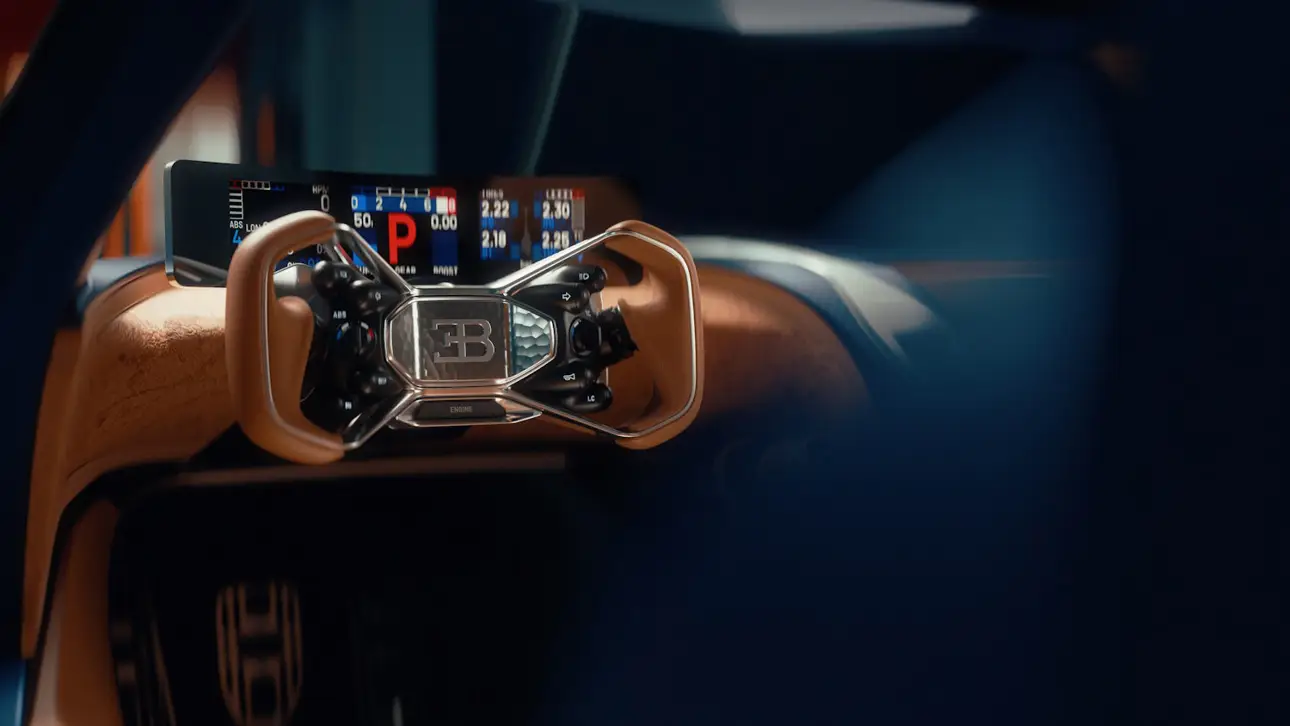
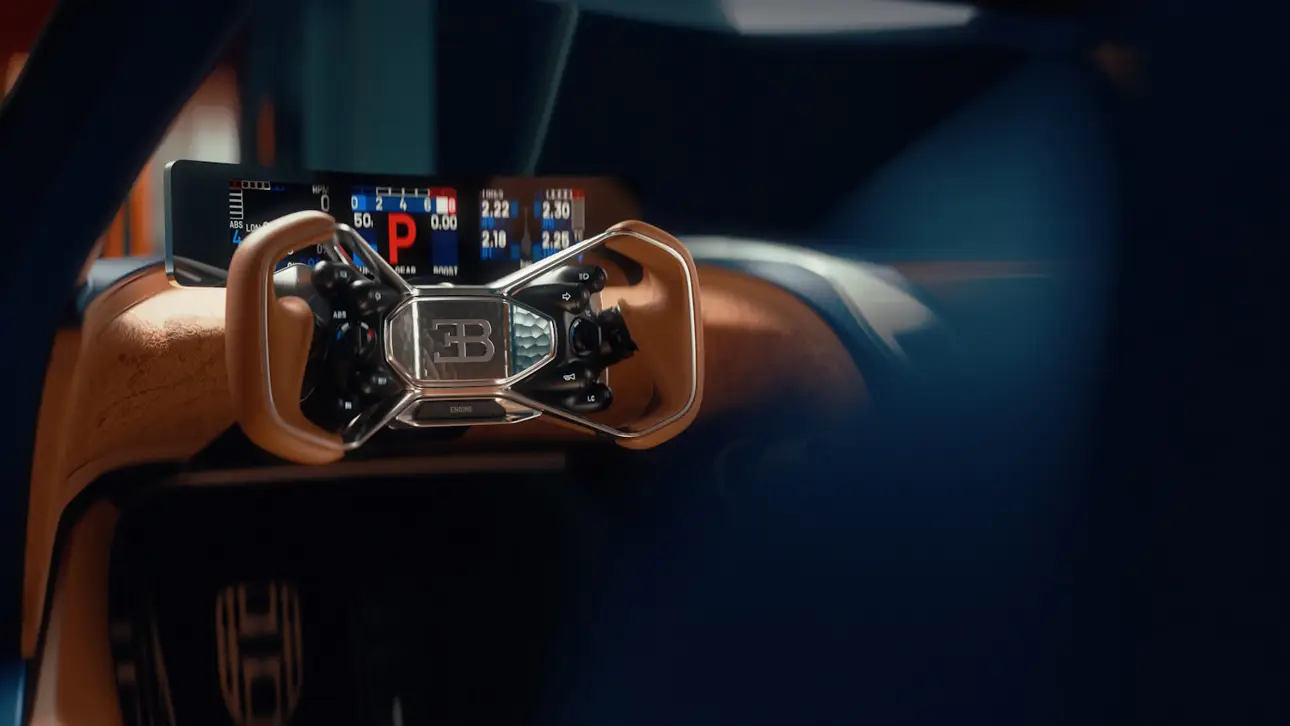
The cabin moves away from the Bolide’s motorsport minimalism altogether. Leather and nubuck in the warm brown Ambre Voyageur meet a seamless 3D-knitted textile: fine copper yarns run through it, forming a circular halo pattern that flows around the interior. Contrasting stitch lines pick out the geometry of each component and return in the headrest embroidery and the lines of the centre console, while the hammered finish carries over from the exterior to the door opener, air vents, steering wheel hub and entry plates. A small French flag sits at the heart of the cabin.
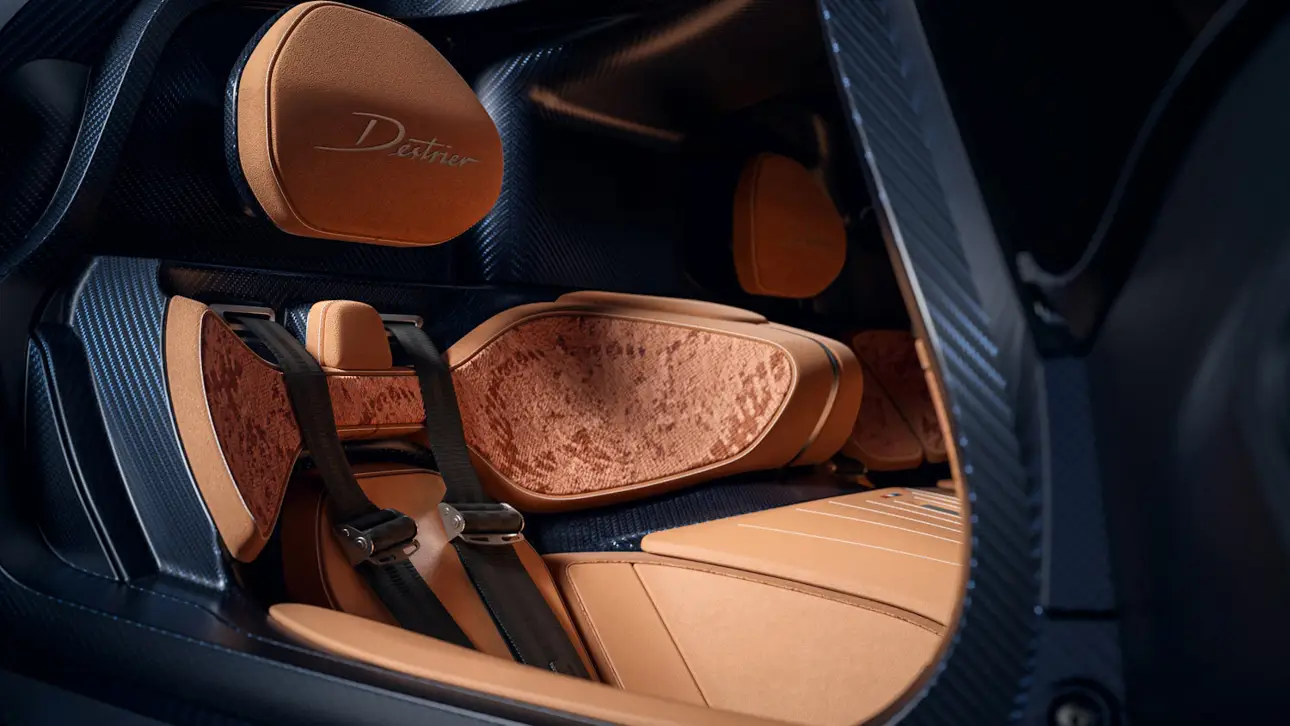
“Every material in Destrier was chosen the way a tailor selects cloth. Ambre Voyageur leather and nubuck bring a warm, human counterpoint to the depth of Sapphire Celeste, while the 3D-knitted textile, threaded with fine copper yarns, wraps the cabin in a single seamless halo. Nothing shouts. Every surface is measured, tactile, and made for one person alone,” said Head of Colour and Trim Sabine Consolini.
The powertrain was left alone: Destrier gets the 8.0-litre quad-turbocharged W16 with 1600 PS. Bugatti itself mentions the engine almost in passing — this car’s story is about proportion and craftsmanship, not numbers. The same unit sits in the production Bolide, which, at a dry weight of 1450 kg, can generate almost 3000 kg of downforce depending on speed. The track-only Bolide was built in a run of 40 cars, is not homologated for public roads, and its production was wrapped up last year, closing the book on the W16.

For Destrier itself, Bugatti has yet to disclose weight, downforce, acceleration, top speed, price or road certification status. Calling it a more comfortable road-going Bolide is therefore premature: the shared engineering package and the engine are confirmed, its intended use is not.
Another unique W16 was the Mistral Blanc Éternel with genuine porcelain details in its body and cabin. Destrier lifts personalisation to the level of a separate body rather than a set of materials and colours.

Parametric patterns feature in the headlamps and tail lamps, while the oil filler cap carries the Destrier emblem alongside the 1/1 designation. The public premiere comes during Monterey Car Week, which culminates in the Pebble Beach Concours d’Elegance on 16 August 2026.
This English edition was prepared using AI translation under editorial oversight by SpeedMe. The original reporting is by Nikita Novikov
Latest Stories