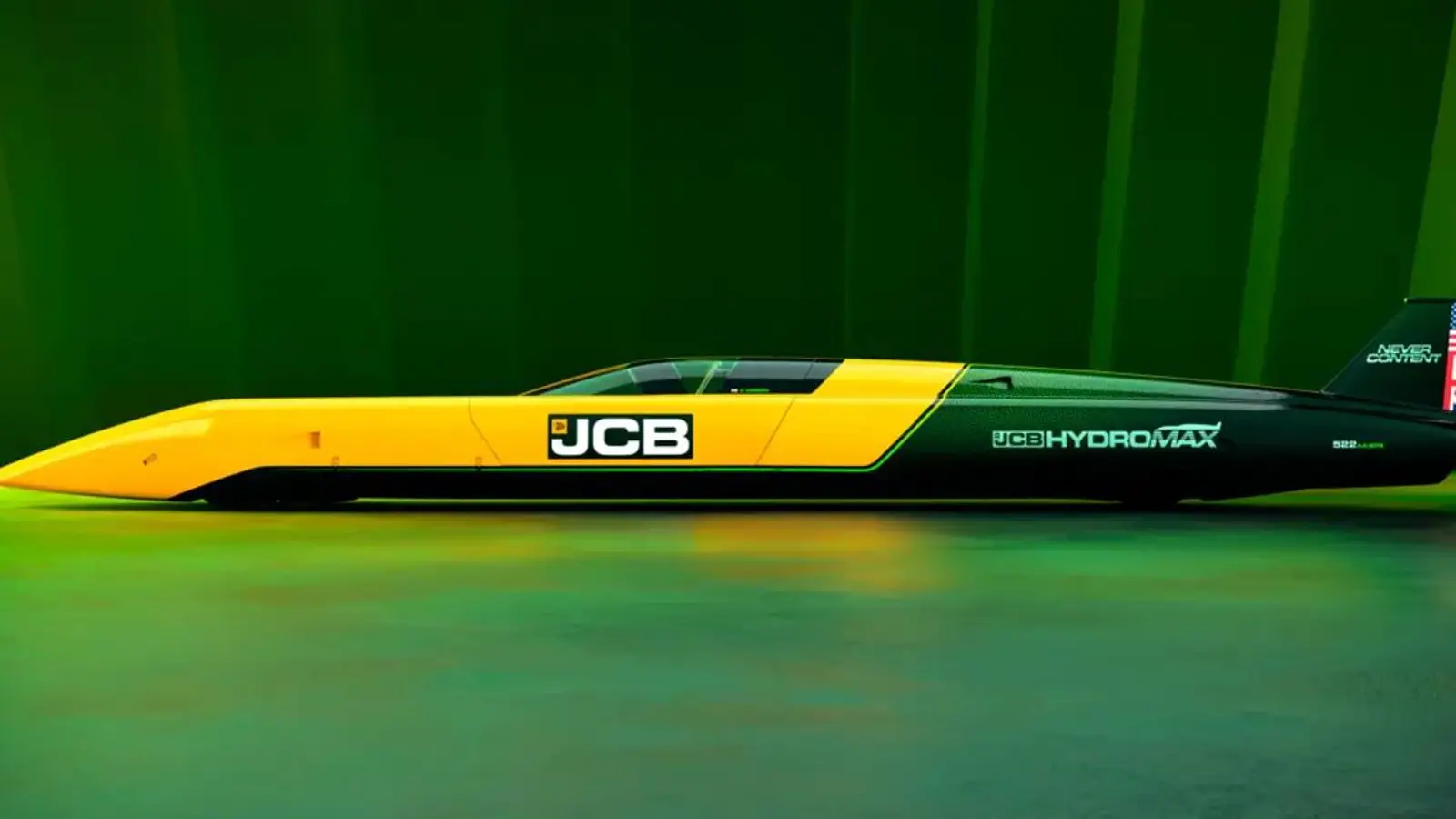
JCB Hydromax: Bonneville speed, hydrogen engine specs and the FIA record attempt
 © jcb.com
Andy Green's hydrogen-engined JCB Hydromax averaged 592.8 km/h at Bonneville, an SCTA class record ahead of the FIA world-record bid on August 11.
Author: Nikita Novikov
592.8 km/h (368.347 mph) — that’s the average speed at which Andy Green has already set an official SCTA record in the hydrogen-powered JCB Hydromax at Bonneville. On Thursday the car hit 590.8 km/h, and on Friday 594.7 km/h; the average of the two runs became the new record in the Blown Gas Streamliner class, beating the Spectre Streamliner’s mark (set in 2010) that had stood for 16 years. That’s 29.4 km/h faster than the JCB Dieselmax achieved back in 2006. The record was reported by the Associated Press.
But it’s too early to rewrite the world-record books: an SCTA class record isn’t the same thing as an FIA world record. For official FIA recognition, the car must complete two runs in opposite directions within 60 minutes on a longer measured course, with the average speed of that separate attempt counted. That attempt is scheduled for August 11. The FIA sets out the rules for certifying the result in detail.
The 9.75-metre Hydromax uses two hydrogen internal-combustion engines built from JCB’s production hardware. Their combined output reaches 1,600 hp. UK testing in June topped out at 335 km/h, meaning the car gained almost 258 km/h after moving to the salt flat. JCB’s official project page also notes that the previous record for a hydrogen-ICE car stood at just 185.5 mph, or around 298.5 km/h.
Here, hydrogen is burned directly in the cylinders — a fundamentally different approach to the fuel cells used by the Hyundai NEXO or Toyota Mirai. Toyota is pursuing a parallel path in motorsport: its GR Corolla H2 is already serving as a test bed for liquid hydrogen, including a 300-litre tank and a superconducting pump.
There’s an important environmental caveat too. The Hydromax’s hydrogen engine doesn’t emit CO2 from the fuel itself through the exhaust, but that doesn’t automatically make the technology “zero” across its full lifecycle: the outcome depends on how the hydrogen is produced, and high-temperature combustion can still produce other emissions. AP reports that JCB is sourcing green hydrogen for the current project.
Green already holds the outright land speed record — 1,227.98 km/h in ThrustSSC in 1997 — and remains the only person to have broken the sound barrier on land. Hydromax isn’t challenging that mark. The task on August 11 is far more specific: turning the SCTA record into an FIA-recognised world record.
This English edition was prepared using AI translation under editorial oversight by SpeedMe. The original reporting is by Nikita Novikov
Latest Stories