Ferrari single windshield wiper patent and guided sliding mechanism
 © uspto.gov
Two Ferrari patent applications describe a single guided wiper that can move laterally across the windshield, cut drag and park beside the A-pillar.
Author: Nikita Novikov
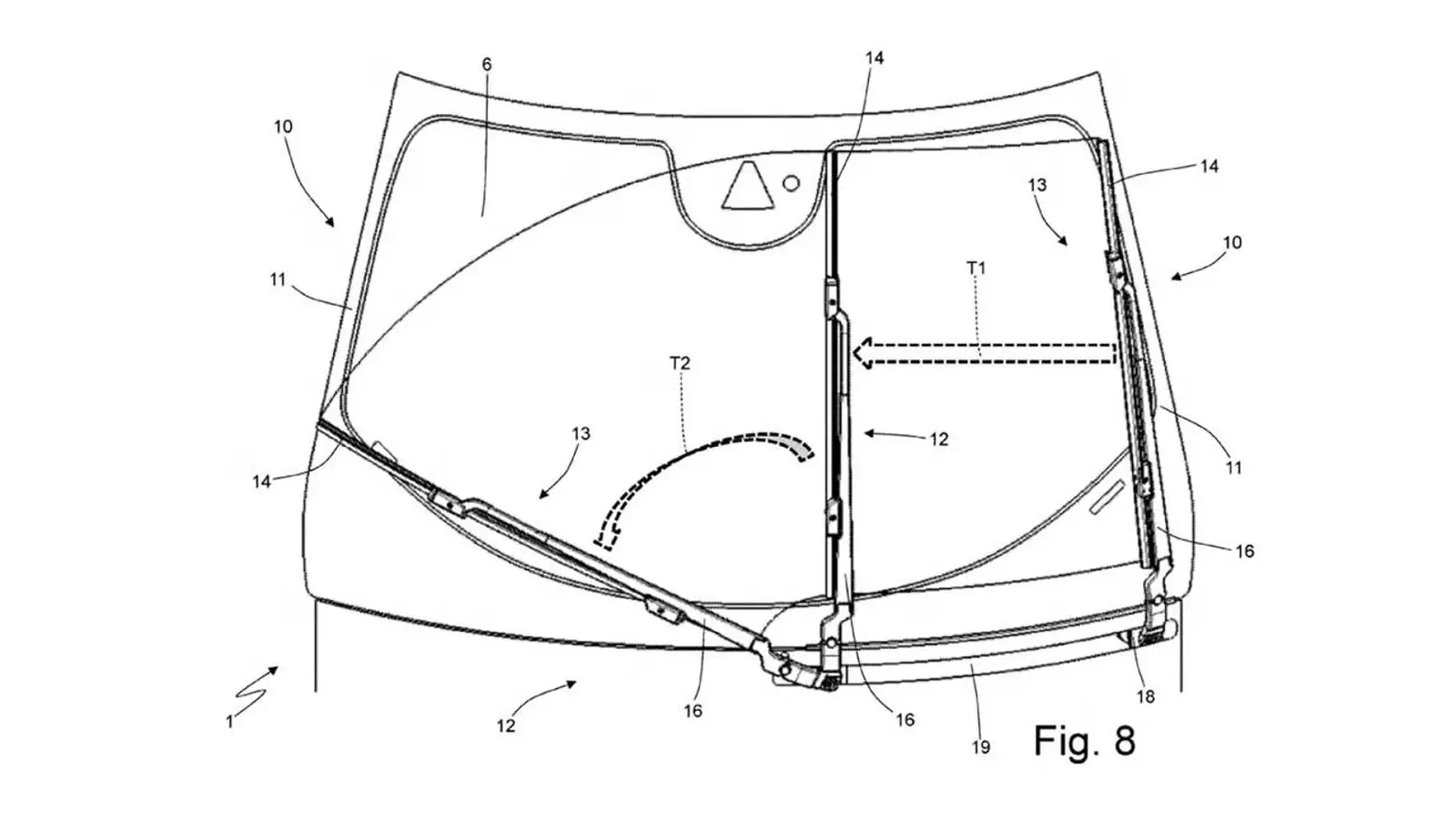
Ferrari has decided to rethink a mechanism that has changed little for decades. US patent applications US20260285256A1 and US20260285259A1, published on September 24, describe a system with a single arm and blade that travels at least part of its path not in the usual arc, but along the windshield while remaining almost parallel to itself. They are two closely related but separate applications with different Italian priority filings, both submitted on March 21, 2025.
In one version, the wiper first slides along a guide and is then rotated by a separate actuator to clean the remaining part of the glass. An alternative layout allows purely translational movement from one side to the other with no rotation at all. The guide can be fixed directly to the lower edge of the windshield, while the carriage can be moved by a conventional electric motor and transmission or by a linear electric motor.
Ferrari is not adding unusual kinematics merely for complexity. At rest, the single wiper sits next to the A-pillar and is intended to blend visually into it. This means engineers do not need a separate recess for the blade at the base of the windshield, and the hood can meet the glass more smoothly. The application explicitly cites lower aerodynamic drag both at rest and during wiping because the arm spends most of its time out of a position transverse to the airflow.
There is a less obvious advantage too. Ferrari considers the design close to universal: adapting it to another model would mainly require changing the curvature of the guide and the blade length. The system can also be adapted comparatively easily for left-hand-drive and right-hand-drive cars. In an emergency mode, the area in front of the driver should be cleared particularly quickly because the blade already starts nearby.
Ferrari has explored other unconventional ways to manage airflow. In August, another patent from the brand described movable rear lights capable of acting as an active-aerodynamics element. The first electric Ferrari Luce takes a different approach to the same objective: its body was developed with particular attention to drag, and its windshield wipers are parked beside the A-pillars.
The new documents still cannot be tied specifically to the Luce or to any next production Ferrari. Both applications describe a device principle and name no future model. Filing a patent application also does not mean the mechanism will necessarily reach production.
This English edition was prepared using AI translation under editorial oversight by SpeedMe. The original reporting is by Nikita Novikov
Latest Stories