Gordon Murray Le Mans GTR: engine, 654 hp, production run and price
 © gordonmurraygroup.com
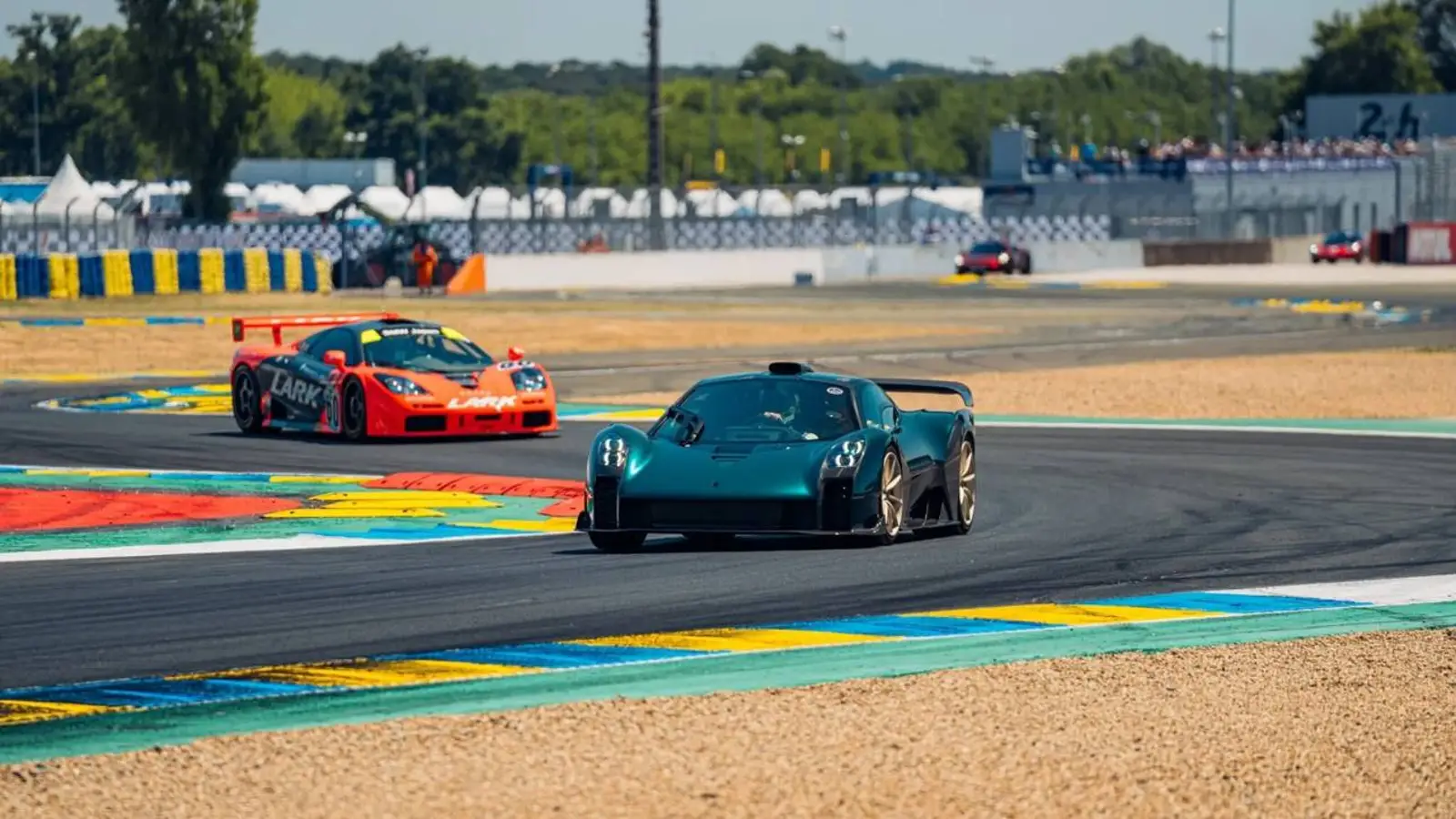
Gordon Murray Automotive ran the Le Mans GTR at Le Mans Classic — a 4.0-litre, 654 hp naturally aspirated V12, rear-wheel drive and a six-speed manual, with just 24 cars to be built.
Author: Nikita Novikov
Gordon Murray Automotive has taken the Le Mans GTR onto a public track for the first time — the hypercar lapped Le Mans Classic alongside a T.50s Niki Lauda and a T.33 prototype. Yet the car’s real story lies elsewhere: Murray dropped the T.50’s signature trick — the rear fan — while keeping what has all but disappeared from the hypercar segment today: a naturally aspirated V12, rear-wheel drive and a six-speed manual gearbox.
The Le Mans GTR shares its core engineering with the T.50 and T.50s. Behind the seats sits a 4.0-litre naturally aspirated Cosworth V12 rated at 654 hp, sending drive to the rear wheels. Set against modern Ferraris, McLarens, the Mercedes-AMG One and hybrid Lamborghinis, the approach looks almost stubborn: there is no chase for batteries or record combined output here, but the mechanical bond between driver and car stays intact.
Visually, the Le Mans GTR departs sharply from the T.50. There is no signature fan and no direct nod to the McLaren F1 as on the S1 LM; instead you get stacked headlights, large air intakes, a carbon front splitter, a stretched body, a big fixed wing, a smooth engine cover and a massive diffuser. The result reads less like a road-going take on a race prototype and more like a standalone interpretation of the GT idea for the track.

At the wheel at Le Mans Classic was GMA test driver Dario Franchitti. The setting was no accident either: parked nearby were cars tied to Gordon Murray’s career, including the McLaren F1 GTR that ran the 1996 24 Hours of Le Mans, a Japanese F1 GTR from the All-Japan GT Championship, a Duckhams LM Ford and the Brabham BT49B, BT44B and BT42.
Just 24 examples of the Le Mans GTR will be built, and the price has not been disclosed yet. This is a story from the world of collector assets rather than the everyday market: cars like this do not compete with the Ferrari 296, Porsche 911 GT3 RS or Lamborghini Revuelto on the usual logic of price and numbers. They are bought as a rare piece of engineering — the last territory where a V12 and a manual still matter more than seconds ticked off in a configurator.
The Le Mans GTR is not trying to be the most high-tech hypercar of the year. Its value is that it leaves the driver the work other brands have already handed over to electronics.
This English edition was prepared using AI translation under editorial oversight by SpeedMe. The original reporting is by Nikita Novikov
Latest Stories