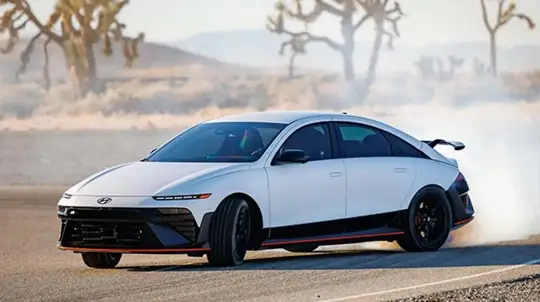
Europe Isn't Buying It: Tesla's FSD Safety Numbers Raise Eyebrows
 © A. Krivonosov
Reuters: Tesla showed European regulators self-reported Full Self-Driving safety data that independent researchers called misleading marketing.
Author: Nikita Novikov
Tesla has hit another wall on Full Self-Driving's road into Europe. According to Reuters, the company presented regulators in Sweden and the Netherlands with its own FSD safety statistics, which independent experts dismissed as something closer to a contested marketing pitch than real proof.
The main complaint isn't that Tesla collects this data at all — it's the comparison methodology. Earlier Reuters investigations and outside reviews raised the same issue: the company stacks crash rates from cars with driver assists switched on against broader or differently sourced national figures. The resulting number ends up looking stronger than the actual picture on comparable roads, with comparable drivers and traffic conditions.
For Europe this is a particularly sensitive subject. Tesla is pushing FSD Supervised, but the Full Self-Driving label itself has long been disputed: the car doesn't become fully autonomous, and the driver is required to watch the road and stay ready to take over. Correspondence between European regulators has already flagged questions about speeding, behavior on tricky surfaces, and the risk that drivers start trusting the system more than they should.
Dutch regulator RDW plays a central role: approval in one country can clear Tesla's path to a wider European rollout. But the European version of FSD has to meet tougher requirements than the American one, and Tesla can't simply transplant the US experience onto EU roads. The stakes are high: without European clearance, FSD remains an expensive feature on a limited market; with it, the company gets ammunition against BMW, Mercedes-Benz, BYD and other brands that also sell assistance systems and semi-automated driving.
For the buyer it all comes down to one question: are you paying for real assistance, or for a promise of a future autopilot? If the system needs constant supervision, then safety statistics need to explain not only «how many crashes per kilometer», but also when the driver intervened, where the car was driving, on what roads and by what rules the incidents were counted.
The most dangerous part of an autopilot sometimes isn't in the code — it's in the expectations of the person behind the wheel.
This English edition was prepared using AI translation under editorial oversight by SpeedMe. The original reporting is by Nikita Novikov
Latest Stories