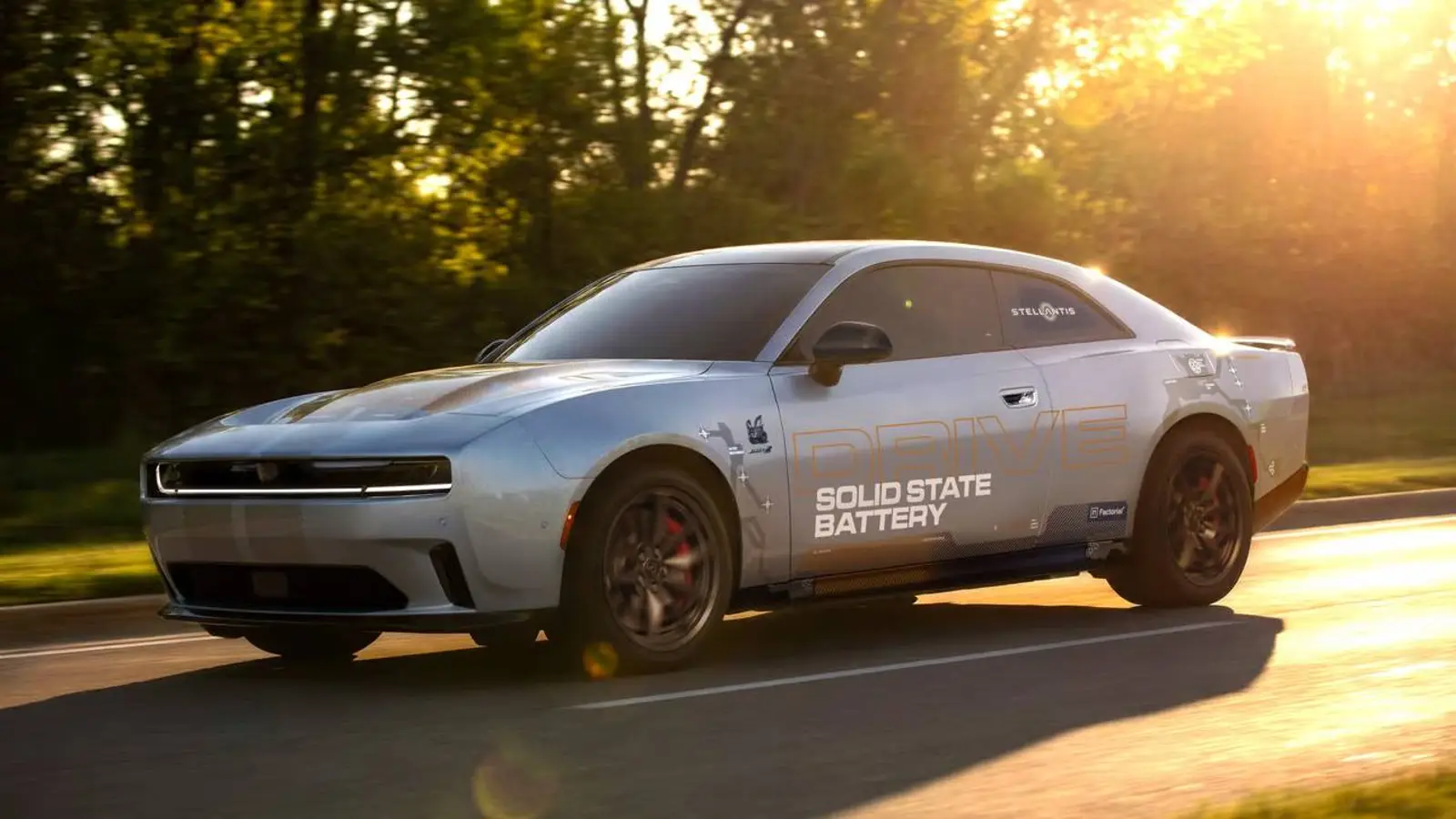
From the lab to the asphalt: a solid-state Dodge hits the road
 © media.stellantis.com
FEST cells promise 375 Wh/kg, a 15-to-90% charge in 18 minutes and stable operation from −30 to +45 °C — and they have just left the lab.
Author: Nikita Novikov
Stellantis has taken a Dodge Charger Daytona fitted with a prototype Factorial solid-state battery out onto the road. For a technology automakers have been talking about for years, this is a meaningful jump from lab promises to a real car.
The project uses a FEST cell — Factorial Electrolyte System Technology. In 2025 Stellantis and Factorial reported an energy density of 375 Wh/kg for these cells, a charge from 15 to 90 % in 18 minutes and stable operation across a temperature range from −30 to +45 °C. Numbers like these matter on several fronts: the battery becomes lighter for the same capacity, charges faster and behaves more reliably in different climates.
Engineers had to do more than drop new cells into a Charger Daytona. Stellantis integrated them into the existing battery pack with a new mechanical architecture and reworked the management systems and pack layout to lift efficiency without giving up safety or durability.
The company has not said how long the testing will last or when such batteries might reach production cars. Many automakers point to the end of the decade as a target, but mass production still requires proof of cycle life, stability and cost.
In this story the Charger Daytona is interesting not only as an electric Dodge. It has become the test bed for a battery expected to deliver lower weight, shorter charging times and greater range without simply growing the size of the pack.
This English edition was prepared using AI translation under editorial oversight by SpeedMe. The original reporting is by Nikita Novikov
Latest Stories